AI, Digital Literacy, and the Growing Risk of Digital Deception

Md Tawhidul Islam
Graduate Researcher · Developer · Designer
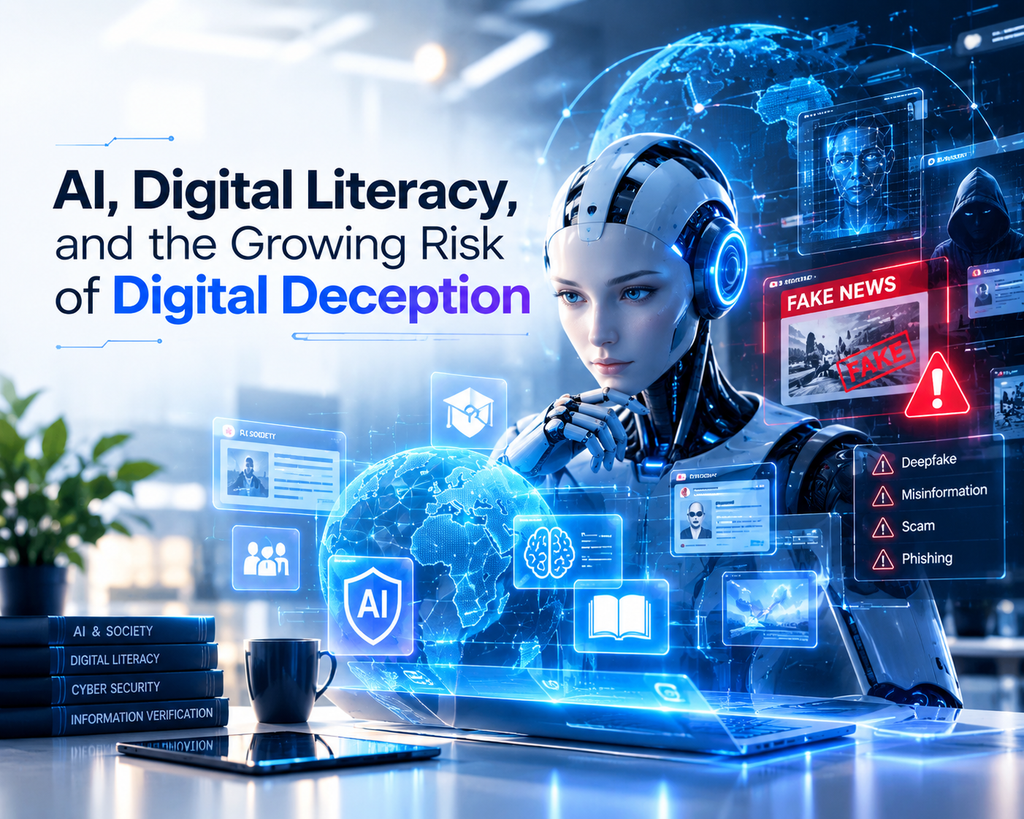
In the last two parts of the Mission: Impossible movie series, Ethan Hunt encounters an enemy that can manipulate information, create uncertainty, and completely alter the reality. The most dangerous part is not simply the technology itself, but the difficulty of knowing what to trust. What if something similar starts happening in our everyday digital lives?
Fortunately, or unfortunately, the situation is not a fiction right now. That is exactly what is currently happening in our digital lives. Artificial intelligence is making it increasingly easy to create realistic text, images, voices, and videos. A person can now encounter content that looks or sounds genuine but may not be authentic. Distinguishing between real and manipulated information can become very difficult for people with limited digital literacy.
A fake video, voice message, image, or social media account can spread very fast before people have a chance to verify it. AI does not create deception itself, but it can make deception faster, cheaper, and more convincing.
How AI Fuels Modern Deception
A ‘viral’ campaign propagated by activist linked to Bangladeshi banned organization Awami League claimed that a jailed Chhatra League activist named Jonaed had achieved a brilliant GPA-5 in his exams from Noakhali prison. Alongside the emotional story was a picture of a polite young boy that melted hearts across the internet. Yet, investigations revealed that no such student existed in that jail, and the photo itself was not a real human being at all. It was an AI-generated face, designed purely to trigger public sympathy and political outrage.
In another incident, a video surfaced of Indian Major General C. S. Mann, seemingly warning that India would occupy neighboring nations like Bangladesh. In reality, the officer had given a completely ordinary talk in Hindi about military hardware. But The Descent fact-checked that the speech is altered using AI voice cloning and lip-syncing,
These cases are not isolated accidents. They reveal the powerful techniques that make modern AI deception so effective:
Looking and Sounding Perfectly Real: AI-generated content can now look and sound so convincing that the traditional signs of fake content—like blurry edges, robotic voices, or awkward grammar—are becoming less obvious every day.
Fake News Photocards That Steal Trust: Most people don't read full articles; they scroll past "photocards" featuring a headline, a quote, and a recognizable logo. Deceivers use AI to copy the exact fonts and layouts of trusted news outlets, borrowing their credibility to make a lie look like breaking news.
Fabricated Visual Evidence: We grew up believing that "seeing is believing." When a false story comes with a realistic photo or a convincing video, our natural doubts fade away because our eyes tell us it must have happened.
Hyper-Scale Generation: In the past, creating propaganda took time and a team of writers. Today, AI can generate hundreds of tailored variations of a fake story in seconds, flooding our feeds before anyone has the chance to verify the facts.
The Real Problem: Lack of Digital and Media Literacy
In a country like Bangladesh, the real challenge is not only the ability of AI to create misleading information, but also the ability of people to recognize and question it. Even among educated people, basic digital literacy and media literacy is very limited. Academic education does not necessarily teach people how to evaluate the credibility of online information, verify sources, identify manipulated content, or distinguish evidence from opinion.
A common pattern is simple here is see-believe-share-make viral. People may trust information because it comes from a familiar person, contains a fabricated news photocard, uses confident language, or confirms what they already believe.
This becomes more dangerous in the age of AI because convincing false content can be produced faster than people can verify it. When users share information without verification, they become part of the distribution system themselves. The problem, therefore, is not only AI-generated deception, it is the combination of powerful AI tools, rapid social sharing, and lack of digital and media literacy.
Discussion (1)
Moderated commentsNaiym
Sep 30, 2026
Agreed
Leave a Technical Comment
Your email address will not be published. Comments are reviewed to ensure constructive discussion.